
Cycles of Resistance
-
Digital Booklet Available Here
1. On Christmas Eve - Darkness of the Womb by Niloufar Nourbakhsh
2. In the aftermath of September 11th - Darkness of the Womb by Niloufar Nourbakhsh
3. And then my son was born - Darkness of the Womb by Niloufar Nourbakhsh
4. In America today - Darkness of the Womb by Niloufar Nourbakhsh
5. The mother in me asks - Darkness of the Womb by Niloufar Nourbakhsh
6. “Qiū Hǎi Táng” (Autumn Begonia) - Two Poems by Qiu Jin by Sophie Xuefei Zhang
7. “Mǎn Jiāng Hóng” (River of Blossoms) - Two Poems by Qiu Jin by Sophie Xuefei Zhang
8. Zachte Krachten (Soft Powers) by Anthony R. Green
9. Maagal (Circle/Perfection) by Michael Wiener
10. The Beauty of Disability by Molly Joyce
11. “River Flow” - Living Water by Lauren McCall
12. “She Doesn’t Trust the Water” - Living Water by Lauren McCall
13. “Living Water” - Living Water by Lauren McCall
14. “I Could Not Allow That To Stand” - AOC Takes the Floor by Jason Cady
15. “What Is So Hard About Saying That This Is Wrong” - AOC Takes the Floor by Jason Cady
16. Kadınlar (The Women) - Al kan kuşak by Özden Gülsün
17. Ben, Zeynep (I am Zeynep) - Al kan kuşak by Özden Gülsün
18. Bir Dünya Kadındır (The World is a Woman) - Al kan kuşak by Özden Gülsün
19. Ben, Ayşe (I am Ayşe) - Al kan kuşak by Özden Gülsün
20. Ben de bir kadının boşluğundan doğdum (I Was Born out of a Woman's Void) - Al kan kuşak by Özden Gülsün
21. Ben, Fatma (I am Fatma) - Al kan kuşak by Özden Gülsün
22. Başka Kadınlar (Other Women) - Al kan kuşak by Özden Gülsün
23. “As-salāmu ‘alaykum” - Prayers of Peace by Myron Silberstein
24. “Śānti-Pāțha” - Prayers of Peace by Myron Silberstein
-
CD’s available for order on Bandcamp & Amazon. Streaming links below:
-
In researching and realizing this album, I have collected many resources for how to get involved in the movements highlighted here.
-
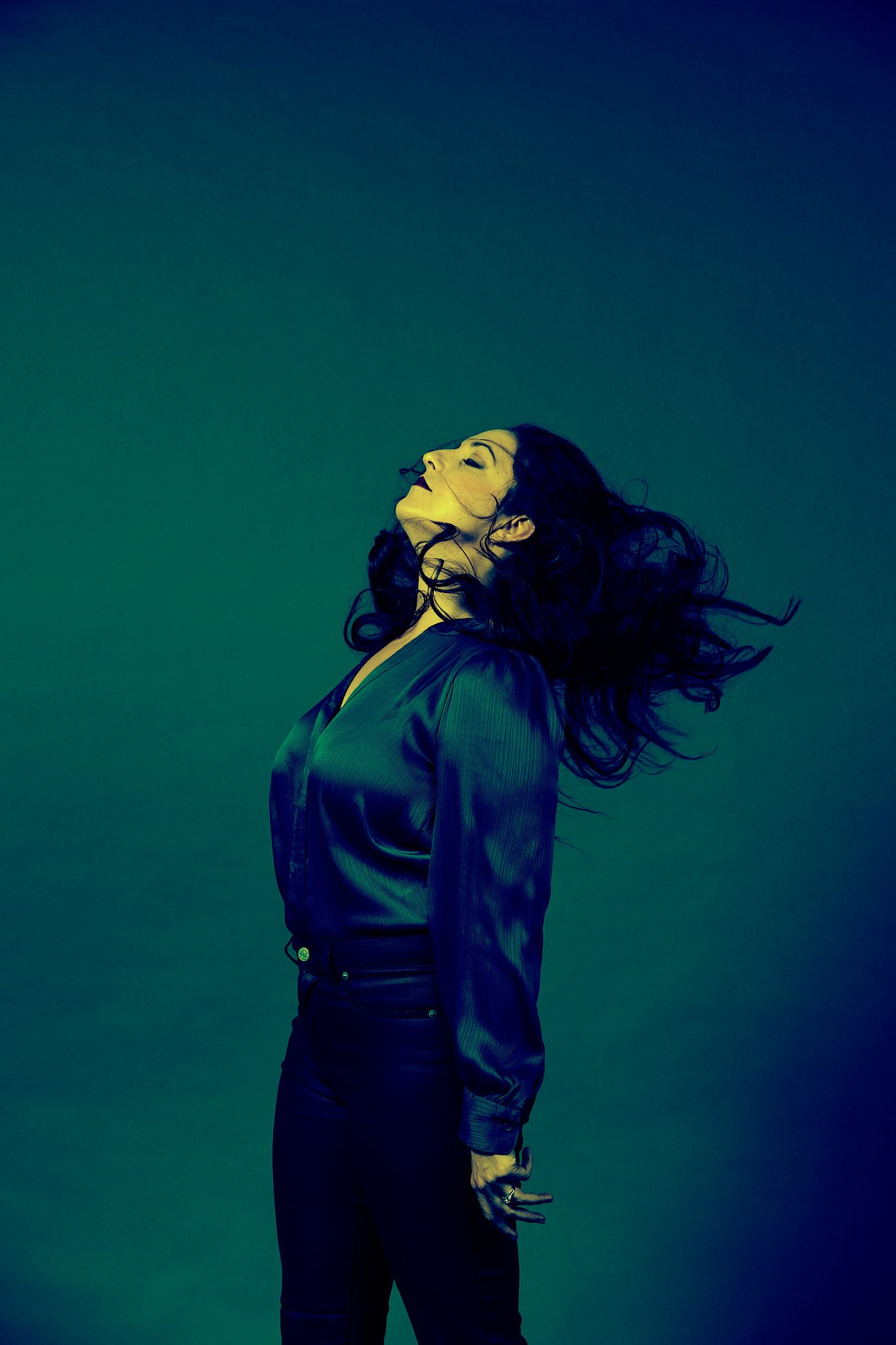
Vero’s photo of me with the Woody Guthrie quote on my neck was just too fabulous of an image. Get your gear here!
I believe that art can serve us in a variety of ways: we can escape into fantastic worlds; we can laugh, smile, and breathe together; we can gain perspective and empathy. Cycles of Resistance expands our perspective. The music and texts lead us on a journey through a series of resistance movements from around the globe over the last 120 years; they are exquisite, powerful, and inspiring–some are tragic. To quote James Baldwin, “Everybody’s hurt. What is important…what drives you, torments you, is that you must find some way of using this to connect you with everyone else alive…You must understand that your pain is trivial except insofar as you can use it to connect with other people’s pain.” He continues to say that when we use this foundational truth to connect to other people, we all are able to heal. We are stronger when we are united and we make better choices when we see the world around us with clarity.
Cycles of Resistance began as a longing for my artist community during the early days of the Covid-19 pandemic. I created a call for proposals for art songs and cycles using texts, themes, or speeches from activists or movements that inspired the composers. In this album, I’ve also included two former commissions and two songs submitted by a composer who’s previous work aligned with our theme of humanity, resistance, and hope.
Program Notes
-
The album begins with Darkness of the Womb, my first commission which inspired my interest in setting speeches to music. Valarie Kaur’s 2016 speech “Breathe and Push” captivated me with the poetic nature and delivery in which Kaur discusses her family’s immigration story, their history of activism, and a response of hope and action in face of the darkness of today’s world. Niloufar Nourbakhsh’s setting begins with a simple ostinato figure, almost as a traveling Bard might begin a tale, and moves into lush piano and vocal figures, punctuated by whispered cadences. As Kaur remembers the long line of ancestors who have resisted persecution, Nourbakhsh adds the use of vocoder to represent the voices of our ancestral wisdom.
-
The album then journeys back to the beginning of the 20th Century in China, where Chinese revolutionary and feminist Qiu Jin fought with sword and pen for the establishment of a republic as well as equality and education of women. Chinese-born Canadian composer, Sophie Xuefei Zhang set “Qiū Hǎi Táng” (Autumn Begonia) with simple melodic lines inspired by Mandarin tone inflection to convey strength and determination. In “Mǎn Jiāng Hóng” (A River of Blossoms), Zhang uses harmonic gestures to echo the note bending timbre of the guqin, as the poetry oscillates between the joy of a spring celebration and the inner struggle for acceptance.
-
From China, we journey to the Netherlands, between the World Wars. Henriëtte Roland Holst, poet and socialist leader, was deeply involved in resistance publications and efforts helping Indonesian immigrants in the Netherlands. After speaking at a large Soviet gathering, she published a book challenging the militant direction she witnessed within the communist movement, which contained the poem “De Zachte Krachten zullen zeker winnen” (The Soft Powers will win in the end). Composer and social justice artist, Anthony R. Green explores this quiet and profound text with a wide range of colors and textures in both the soprano and piano writing. Green utilizes whispers and hand friction percussion as the text mentions the “soft powers” growing and ever-present, “like the sound of the ocean in a shell.” The vocal line soars as the poem hopes for “all of nature and celestial bodies” to move towards “all encompassing love,” finally settling in the comfort that surely good will prevail.
-
Human resilience is a powerful force for growth and progression found even in the depths of atrocity. From the Girls of Room 28, Therisienstadt, we see this is still true. “We shall drive every evil away…won’t go home until we have succeeded…clasp our hands together and sing this anthem from home.” This chant and anthem was created as a means of ritual and support for the children who passed through Room 28. In commemoration and celebration of the community, art, and culture created between these young people, composer Michael Wiener arranged their Czech folk melody and anthem text to include harmonies, sound clusters, and melodies of fellow Theresienstadt prisoner and composer, Viktor Ullmann as well as a Hebrew folk song, the Slovak national anthem, and a Lutheran chorale. Together with prepared piano elements, looper pedal, and ad libitum layering of piano and voice, this work takes the listener on a journey through the multi-cultural and multi-generational community of Theresienstadt.
-
The Beauty of Disability by Molly Joyce honors the work and words of Judith Heumann and reminds us “disability is a family that you can join at any point in your life.” The vocal line begins determined and inviting but develops into an inspirational power, weaving together text from an interview between Joyce and Heumann with contributions from writer Marco Grosse. The piano anchors the ensemble with undulating cells upon which sparkling figures emerge, eventually driving into urgent textures to support the text’s call to action, “won’t you come join at any time?”
-
Living Water is a three-movement work for solo soprano, piano, and electronics. Composer Lauren McCall created ethereal backing tracks in Max/MSP using a machine learning model and data from the Flint Water Blood Lead Level Testing Results. The three songs move through the emotions of not knowing what and who to trust into the solidarity and catharsis of community organizing. McCall’s lyrical writing is comforting and a contemplative accompaniment to the almost folksong storytelling. “River Flow” begins with a shimmering electronic track and flowing vocal line as the crisis develops. The electronic shimmer becomes a stagnant and haunting pulse as a mother questions what is safe for her child in “She doesn’t trust the water” supported by descending figures in the voice and piano. “Living Water” urges us onward in text and music to inspire action and community organizing.
-
Another beacon of activism and sensibility, Representative Alexandria Ocasio-Cortez has been continuously celebrated for speaking up to defend those she represents as well as setting an example for how to respond to bullying, harassment, and the sexism she has experienced as a congresswoman. Her words are deliberate in exposing a wider perspective of how this behavior affects everyone. AOC Takes the Floor is a set of two songs composed by Jason Cady, a constituent of AOC’s 14th District, and co-commissioned by me and Lisamarie Eldredge. This work also features a modular synthesizer throughout, performed here by Jason Cady. The first song, “I Could Not Allow That to Stand” uses the text from AOC’s response to Florida Representative Ted Yoho’s verbal harassment on the steps of The Capitol. In her response, she admits that she wasn’t “waiting for an apology, but what I do have issue with is using women—our wives and daughters—as shields and excuses for poor behavior.” Cady sets the vocal line carefully following AOC’s speech patterns, sometimes delivered more like recitative and other times moving towards sweeping melodic lines which make use of Lydian and Pelog scales. The overall form is inspired by the modulation structure of John Coltrane’s “Giant Steps.” The text from second song, “What is So Hard About Saying that This is Wrong” is taken from Ocasio-Cortez’s response to Representative Paul Gosar’s tweet of a violent Anime video depicting him murdering AOC. Here, she calls out the danger of claiming humor as an excuse, “this is not about me…but it is about what we are willing to accept.” She addresses the nihilism that develops when leaders don’t hold themselves to the gravity of their position and reminds her colleagues, “Our work here matters. Our example matters. There is meaning in our service.” Developing musical ideas presented in the first song, Cady incorporates motivic gestures in the piano and modular synthesizer replacing the fourth of the Lydian scale with the raised sixth of the Dorian. The vocal line follows similar speech patterns but often cadences with sweeping quintuplet runs.
-
(trigger warning: discussion of domestic violence)
AOC’s leadership gives women worldwide an example of how to stand up for themselves and each other. While we have come a long way, there is still much to do. Turkey, which led the European Union in 2011 to address issues of domestic violence with its Istanbul Convention, has now become the only country to withdraw from the effort, caving to pressures from religious and conservative lobbying. Protestors and organizers are demanding criminal consequences for acts of domestic violence; murders that go completely unpunished because law enforcement views them as a matter of the home. Turkey is not alone in the rates of domestic violence and the United Nations released a global report in 2020 stating that every 11 minutes, a woman is murdered by a family member or intimate partner. Al kan kuşak is a song cycle composed by Özden Gülsün with libretto by Didem Gülçin Erdem which addresses the Turkish Femicide weaving together three tales of domestic violence with supportive cheers and chanting of protesters. The work opens with an ominous taunt in the piano and the admission that the community has “known women who had to wait for dark to escape” and the familiarity of broken tools, homes, and mothers. Much of the soprano line oscillates from wailing melodic phrases to restrained and whispered tones as the text recognizes the pain and paralysis of the affected women with vocoder reverberating such experiences. The tales of Zeynep, Ayşe, and Fatma each expand on a dirge in the piano while the vocal line explores who these women were before their lives were cut short by beating, stoning, or being thrown from the 40th floor of a building. The music and text brilliantly balances the tragedy with moments of discovery where real-life protest recordings are inserted into the texture, eventually leading to the fifth movement where a young woman questions her treatment and joins the movement. Again, vocoder is used to represent the collective protesting voices quoting cheers and listing names of victims, a practice inspired by the online tracker: anitsayac.com.
-
Human resilience is a common thread throughout the album leading to the final work, Prayers for Peace by Myron Silberstein. Purposefully saved for the end, these two song settings of an Islamic greeting and a Vedic meditation are a grounding force for contemplation and presence. News cycles, schedules, and the commotion of daily life too often create a sense of numbness to deep processing; a compartmentalization of our human responses to tragedy and outrage. When we are numb, it is easy to forget or prioritize other thoughts, but we miss out on the community and creativity we gain from collaborating with each other. “As-salāmu ‘alaykum” is a daily greeting of “peace, mercy, and blessings” to one another. The piano begins with quiet descending figures to realize the contemplative harmonic progression while the soprano explores the greeting in arched melodies, eventually expanding into an evocation of Allah’s blessings over ascending arpeggios in the piano. “Śānti-Pāțha” begins with a melismatic “om,” the sacred mantra of consciousness and the divine over grounded piano harmonic gestures. The text inspires both the vocal and piano writing into an expansive and more urgent recognition of peace outward to the heavens, around us on the planet, and even to peace itself; finally surrendering to ask for peace returning to the speaker. Silberstein closes with a return to that melismatic invocation of “om” and a repeated mantra of “Śānti” (peace).
-
Remembering James Baldwin’s comment on pain, it is not the hurting or dwelling that matters but the way we use that to fuel our ability to connect to each other’s experiences and walk onwards together. In researching and realizing this album, I have collected many resources for how to get involved in the movements highlighted here.
I have so much gratitude for the people who made this project possible: Jordan, thank you for your love and support in taking on such a massive project. Taylor, you have been a wonderful collaborator in preparing these new works and bringing them to life. Your patience, intentionality, and musicality has been a force of inspiration for my own artistry. To the activists, poets, and organizers who spend their lives inspiring us to be better and do better, thank you. Your work is a source of guidance for my actions and turning your words into art music has been a great privilege. Lisamarie, thank you for jumping on as co-commissioner for AOC Takes the Floor, it has been a thrill to sing and I’m so glad they exist! Meerenai, thank you for your guidance and belief in this project, both of which elevated my passion project into a professional and polished album. Alberto, thank you for your patience, ear, and expertise! I learned so much recording and editing with you in the studio. Last, but not least, Elizabeth, thank you for inspiring me to find new ways of connecting to my art that felt true to myself. #BigRamen
Texts & Translations
-
from “Breathe and Push” by Valarie Kaur (2016)
Waheguru Ji Ka Khalsa, Waheguru Ji Ki Fateh. (The beloved community belongs to divine Oneness, and so does all that it achieves.)
On Christmas Eve 103 years ago, my grandfather waited in a dark and dank cell. He sailed by steamship across the Pacific Ocean from India to America leaving behind colonial rule, but when he landed on American shores immigration officials saw his dark skin, his tall turban worn as a part of his Sikh faith, and saw him not as a brother but as foreign, as suspect, threw him behind bars where he languished for months until a single man, a white man, a lawyer named Henry Marshall filed a writ of habeas corpus that released him, Christmas Eve 1913.My grandfather Kehar Singh became a farmer, free to practice the heart of his Sikh faith—love and oneness. And so when his Japanese American neighbors were rounded up and taken to their own detention camps in the deserts of America he went out to see them when no one else would. He looked after their farms until they returned home. He refused to stand down.
In the aftermath of September 11th when hate violence exploded in these United States and a man that I called uncle was murdered. I tried to stand up. I became a lawyer like the man who freed my grandfather and I joined a generation of activists fighting detentions and deportation, surveillance and special registration, hate crimes and racial profiling. And after 15 years with every film, with every lawsuit, with every campaign, I thought we were making the nation safer for the next generation.
And then my son was born. On Christmas Eve, I watched him ceremoniously put the milk and cookies by the fire for Santa Claus. And after he went to sleep, I then drank the milk and ate the cookies. I wanted him to wake up and see them gone in the morning. I wanted him to believe in a world that was magical. But I am leaving my son a world that is more dangerous than the one I was given. (Because) I am raising—we are raising—a brown boy in America, a brown boy who may someday wear a turban as part of his faith.
And in America today, as we enter an era of enormous rage, as white nationalists hail this moment as their great awakening, as hate acts against Sikhs and our Muslim brothers and sisters are at an all-time high, I know, I know that there will be moments whether on the streets or in the school yards where my son will be seen as foreign, as suspect, as a terrorist. Just as black bodies are still seen as criminal, brown bodies are still seen as illegal, trans bodies are still seen as immoral, indigenous bodies are still seen as savage, the bodies of women and girls seen as someone else’s property and when we see these bodies not as brothers and sisters then it becomes easier to bully them, to rape them, to allow policies that neglect them, that incarcerate them, that kill them.
Yes, rabbi, the future is dark. On this New Year’s Eve, this watch night, I close my eyes and I see the darkness of my grandfather’s cell. And I can feel the spirit of ever rising optimism in the Sikh tradition Chardi Kala (ever-rising high spirits) within him.
And so the mother in me asks what if? What if this darkness is not the darkness of the tomb, but the darkness of the womb? What if our America is not dead but a country that is waiting to be born? What if the story of America is one long labor? What if all of our grandfathers and grandmothers are standing behind us now, those who survived occupation and genocide, slavery and Jim Crow, detentions and political assault? What if they are whispering in our ears today, tonight, “You are brave”? What if this is our nation’s great transition?
What does the midwife tell us to do? Breathe. And then? Push. Because if we don’t push we will die. If we don’t push our nation will die. Tonight we will breathe. Tomorrow we will labor in love through love and your revolutionary love is the magic we will show our children.
-
秋海棠
Qiu Jin (1875-1907)栽植恩深雨露同,一丛浅淡一丛浓。
平生不借春光力,几度开来斗晚风?“Autumn Begonia”
Qiu Jin (1875-1907)
Translation by Chelsea HollowMy love, planted and watered together with rain and dew.
One shrub一clarity. Another shrub一density.In this one life, I will not borrow power from the light of spring.
Blooming on my own and fighting the night wind.
Rain and dew 一 no 一 power of spring.满江红
Qiu Jin (1875-1907)小住京华,早又是中秋佳节。为篱下黄花开遍,
秋容如拭。四面歌残终破楚,八年风味徒思浙。
苦将侬强派作蛾眉,殊未屑!身不得,男儿列,心却比,男儿烈!算平生肝胆,
不因人常热。俗子胸襟谁识我?英雄末路当折磨。
莽红尘何处觅之音?青衫湿!“River of Blossoms”
Qiu Jin (1875-1907)
Translation by Chelsea HollowA brief stay in the splendid big city, it is already The Mid-Autumn Festival. Under the fences, yellow flowers are blooming away the visage of autumn, as if freshly washed. From all around there is song and celebration, an abrupt shift from the pain of war. The distinct taste of 8 years at war still lingers; all the time longing for Zhejiang (her home). But at home, I was forced into the role of the beautiful, unyielding housewife and that life destroys my essence.
My female body may not be the form of a warrior; my heart, however, is the very form of the fiercest of them all! I am more than just the body you see; we all are. How can such unimaginative minds really understand me? A hero must withstand persecution, in the end. In the thick weeds of humanity, where can I find my soulmate? My uniform is drenched in tears.
-
De zachte krachten zullen zeker winnen (1918)
by Henriëtte Roland Holst (1869-1952)De zachte krachten zullen zeker winnen
in ’t eind–dit hoor ik als een innig fluistren
in mij: zo ’t zweeg zou alle licht verduistren
alle warmte zou verstarren van binnen.De machten die de liefde nog omkluistren
zal zij, allengs voortschrijdend, overwinnen,
dan kan de grote zaligheid beginnen
die w’als onze harten aandachtig luistrenin alle tederheden ruisen horen
als in kleine schelpen de grote zee.
Liefde is de zin van ’t leven der planeten,
en mense’, en diere’. Er is niets wat kan storen
’t stijgen tot haar. Dit is het zeekre weten:
naar volmaakte Liefde stijgt alles mee.The gentle forces shall certainly win
translation by Anthony R. GreenThe soft powers shall certainly win
in the end–I hear this as an internal whispering
in my soul: if it is silenced, all light will darken
all warmth will freeze from within.It shall with great effort overcome
the powers that still shackle love;
Then great salvation can begin;
we'd hear it rustle, like the oceanin tiny seashells, if our hearts
would devotedly and tenderly listen.
The deep desire of celestial bodies,
animals, and people, is love. Nothing can stop
the thrust towards it. This is certain:
everything moves towards all-encompassing love. -
Maagal (1943)
The Girls of Room 28Věříš mi – věřím ti, víš a vím,
buď jak buď, nezradíš –nezradím.My chceme jeden celek být
chceme se vesměs rádi mít
chceme a budem,
přišli jsme a půjdem,
chceme se domů navrátit.My půjdem proti zlému
klestíme cestu dobrému,
my zlo zatratíme,
dřív se nevrátíme,
pak zazpíváme píseň svou:Ma’agal musí zvítězit,
nás k dobré cestě obrátit,
ruce si podáme,
pak si zazpíváme
hymnu našeho domova.Nun danket alle Gott
mit Herzen, Mund und Händen,
der uns von Mutterleib
und Kindesbeinen anMaagal (Circle/Perfection)
Translation by Michael Wiener (2020)You believe me—I believe you.
You know what I know,
Whatever may happen,
you won’t betray me—I won’t betray you.We want to be united,
To stand together, to like each other.
We have come here, but our hope,
A hope that shall come true,
Is to return home again.We shall do battle with evil
And forge the path to the good.
We shall drive every evil away
And won’t go home until we have.
And then we shall sing:Ma’agal (Circle/Perfection) must triumph
And bring us on the path to good.
We clasp each other’s hands
And sing this anthem of our home.Now thank we all our God,
with heart and hands and voices,
Who from our mothers’ love
and in their kind arms. -
The Beauty of Disability (2020)
by Judith Heumann, Marco Grosse, and Molly JoyceI encourage you all to recognize
that disability is a family
that you can join at any point in your life.There is nothing uniform
only diversity
but there is commonality
of humanity
of plurality
of one minority
of disability.What does it mean to be the same,
or different?What does it mean to be looked at,
as not the same
by them.Looked as an illness
not as a disability.We are denied opportunities
based on perception of who we are.There is commonality
of humanity
there is one plurality
of minority
of diversity
of disability.Won’t you come join
at any time?
Won’t you come join
in your life? -
Living Water by Lauren McCall (2020)
I. River Flow
River flow, a story to tell
Little did we know what you contain;
Turn of a switch, a toast to change,
—but at what cost?Winter of ‘14, summer of ‘15,
we suspect there’s poison in the water.
Fall of ‘14, spring of ‘15,
What will it take to be heard?River flow, a story to tell
Little did we know what you contain;
With the signing of a pen, our lives were changed.
Why does it come to this cold hard cash?
Can you hear our cries?
Fall of ‘14, spring of ‘15,
What will it take to be heard?Winter of ‘14, summer of ‘15,
we suspect there’s poison in the water.
What does it take? What will it take to be heard?River flow, a story to tell,
Leaching lead into our bonesII. She Doesn’t Trust the Water
She doesn’t trust the water.
Weariness echoing, like my voice within.
“I don’t want it, mama.”
Is that her voice or the one inside?Days roll by, but still
I remember how officials say it’s clean;
Still my baby struggles to breathe.She doesn’t trust the water.
Weariness echoing, like my voice within.
“I don’t want it, mama.”
Is that her voice or the one inside?Days roll by, but still
I remember how officials say it’s clean;
Still my baby’s so ill.I don’t trust officials, or the water.
This is my voice, same as the one within
We want clean water. Our voices sing as one.
Time passes by but still I remember.III. Living Water
Let it start with my steps, let it begin.
I will walk beside you through the troubles and pain.Let us walk Living Water, strength never failing;
Fountains will never run dry;
A reckoning Living Water, strength never failing;
Inequity, rectified.Let our lives be redemption to the neglect.
Let our lives speak volumes, our actions justice provideLet us walk Living Water, strength never failing;
Fountains will never run dry;
A reckoning Living Water, strength never failing;
Inequity, rectifiedYour struggles, your pain
will no longer be ignored,
we’ll keep walking ‘till justice is restored.Let us walk Living Water, strength never failing;
Fountains will never run dry;
A reckoning Living Water, strength never failing;
Inequity, rectified. -
I Could Not Allow That To Stand (2020)
by Representative Alexandria Ocasio-CortezTwo days ago I was walking up the steps of the capitol when Representative Yoho accosted me.
Put his fingers in my face; he called me disgusting. He called me crazy. He called me out of my mind. He called me dangerous. And I quote, “a fucking bitch.” These were the words that Rep. Yoho levied against a congresswoman. The congresswoman that not only represents New York’s 14th congressional district, but every woman in this country. Because all of us have had to deal with this in some form, some way, some shape, at some point in our lives.
Representative Yoho’s comments were not deeply hurtful to me because I have worked a working class job. I have waited tables in restaurants. I have ridden the subway. I have walked the streets of New York City. I have tossed men out of bars. This kind of language is not new, and that is the problem.
Mr. Yoho was not alone; he was walking with Rep. Roger Williams. This is not about one incident; it is a culture of impunity, of accepting violence and violent language against women, and a structure of power that supports that; because not only have I been spoken to disrespectfully by members of the Republican party, but the president told me to “go home to another country.” Governor DeSantis called me a “whatever-that-is.” Dehumanizing language is not new; incidents like these happen in a pattern.
I honestly thought I was just going to pack it up and go home. It’s just another day, right? But then yesterday Rep. Yoho decided to make excuses for his behavior; and that I could not let go. I couldn’t allow my nieces—I couldn’t allow the little girls that I go home to—I could not allow victims of verbal abuse and worse to see that excuse, and to see our congress accept it as legitimate. I could not allow that to stand. I will not stay up late waiting for an apology, but what I do have issue with is using women—our wives and daughters—as shields and excuses for poor behavior. Mr. Yoho mentioned that he has a wife and two daughters. I am someone’s daughter, too.
My father, thankfully, is not alive to see how Mr Yoho treated his daughter. My mother got to see Mr. Yoho’s disrespect on the floor of this House towards me. In using that language in front of the press, he gave permission to use that language against his wife, his daughters, women in his community; and I am here to stand up to say, that is not acceptable. I will not allow people to create hatred in our hearts. Having a daughter does not make a decent man. Having a wife does not make a decent man. Treating people with dignity and respect makes a decent man.
What Is So Hard About Saying That This Is Wrong (2022)
by Representative Alexandria Ocasio-CortezIt is sad, it is a sad day in which a member who leads a political party in the United States of America cannot bring themselves to say that issuing a depiction of murdering a member of Congress is wrong.
What is so hard about saying that this is wrong?
This is not about me, this is not about Representative Gosar, but this is about what we are willing to accept. Not just the Republican leader but I have heard other members of this party advance the argument, including Representative Gosar himself, the illusion that this was just a joke. That what we say and what we do does not matter, so long as we claim a lack of meaning.
Now this nihilism runs deep and it conveys and betrays a certain contempt for the meaning and importance of our work here. That what we do, so long as we claim that it is a joke, doesn’t matter. That what we say here doesn’t matter. That our actions everyday as elected leaders in the United States of America doesn’t matter. That this chamber and what happens in it doesn’t matter. And I am here to rise, to say that it does. Our work here matters. Our example matters. There is meaning in our service.
I grew up as a little girl with awe about our nation’s Capitol. The reverence and the importance and the gravity of our work here. So, the question that I pose to this body in response is: Will we live up to our promises that we make our children? That this is a place where we will defend one another regardless of beliefs. That our core human dignity matters.
-
Al Kan Kuşak (2020)
by Didem Gülçin ErdemI. Kadınlar
Kararsın diye gözleri durup bekleyen kadınlar tanıdım
Çıkılacak sanıyorlardı kuyudan derin söyledikçe
Evlerde işe yaramayan şeyler vardı
Mandal takımları ve ipler ve anneler
BİLMEKLER, GİTMEKLER, ÖLMEKLER
Bir evin yüklüğü olmak nedir, bildik.II. Ben, Zeynep
Benim adım Zeynep.
Ben Zeynep, annemin gölgesinden doğdum
Babamın dinmez öfkesinden
Bir kadının yedinci kızı olarak doğdum
Aldım annemin gözlerini kendi yüzüme koydum
İnsanın içi durmadan nasıl kanar, bildimIII. Bir Dünya Kadındır
Annem limon kabuğundan kendi Türkçesini yapıyor
Henüz eklem ağrısı yok
Bir kadın en fazla beyaz olabilir
Faytona binmişse, yelkovan.
YANLARI AĞRIYAN BİR DÜNYA KADINDIR
“İçim ağrıyor!” diyen de annemIV. Ben, Ayşe
Benim adım Ayşe.
Ben Ayşe, penceresi göğe açılmayan Ayşe
Ne istediği hiç sorulmayan Ayşe
Kırk kat perdeyle örttüler üstümü
Herkes bir avuç toprak attı yüzüme
Toprak kanla nasıl renk alır, bildim.V. Ben de bir kadının boşluğundan doğdum
Ben de eskiden kız çocuğuydum bacakları olan
BEN DE ESKİDEN BİR SAK SI BİR ISIRGAN
Beni siz üfleyip soğumam için hanım hanım
Sabah uyanmaklar, akşam neredesin’ler
Dur o kuşağı beline o kuşağı geçmişine ve de
Dur ben canımı boynuna
Dur canım burnumda ve de
BEN DE BİR KADININ BOŞLUĞUNDAN DOĞDUM
Kendimi biraz suladım, mor menekşe oldum.VI. Ben, Fatma
Benim adım Fatma.
Ben Fatma, iri, kara bir el kapattı ağzımı
Göğsüme ölüm çullandı
Daha göğü emzirecektim, daha kendim büyüyecektim
Kendimin kırkıncı katından içime atladım
Tıknefes bir hayat nasıl yaşanır, bildim
Daha göğü emzirecektim, önce kendim büyüyecektimVII. Başka Kadınlar
Bir Anadolu kadınına güneş dedim, boynundaki ortaçağı gösterdi
SEKİZ TONLUK AİLE SAADETİ ALTINDA EZİLDİ BİR BAŞKA KADIN
—Gülünya, İpek, Ceylan
Birden bir yoksulluk oldu sonra ekimin sekizi şubatın yirmi sekizi gibi
—Yasemin, Hande, Canan
Hiç topuklu ayakkabı giymemişinden
—Hülya, Gamze, Özgecan
Hiç heves etmemişinden, Hiç heves nedir bilmeyeninden
Yoksulluk en çok kadına olur bildim.The Bloody Red Belt (2020)
Translation by Didem Gülçin Erdem and Chelsea HollowI. The Women
I’ve known women who had to wait for dark to escape.
As deep as they were in their wells, they still thought they could get out.
At home, there were things that didn't work:
clothespins and ropes
—and mothers
KNOWING, GOING, DYING.
What it is to carry the burden of a house, we knew.II. I am Zeynep
My name is Zeynep.
I am Zeynep, born from my mother's shadow;
born of my father's unrelenting rage;
born the seventh daughter of a woman.
I took my mother’s eyes and put them on my own face.
How it feels to live with the pain of internal bleeding, I knew.III. The World is a Woman
All my mother knows of the world, she squeezed from lemon peels.
She doesn’t yet have joint pain, but so many bruises;
She’s never received gratitude or praise
—besides the fact that her white body will bring white children.
But if she rides that carriage too soon, she’s promiscuous.
THE WORLD IS FULL OF WOMEN WITH ACHING SIDES!
"It hurts me!" moans my mother.IV. I am Ayşe
My name is Ayşe.
I am Ayşe, a never-opened window, Ayşe.
Never once asked for anything, Ayşe.
Forty layers of curtains kept me hidden from the world
Before everyone threw a handful of dirt,
Threw it on my face.
What color you get when you mix dirt with blood, I knew.V. I Was Born out of a Woman's Void
I used to be a girl with good legs
I USED TO BE A HOT TEA KETTLE, BREWING PASSION
You blew on me to cool me off
—“Be more ladylike!”
Waking up fresh in the morning, being interrogated
—“Where were you at night?”
Stop with the chastity belt; stop binding me to your past;
And also, stop strangling my life; stop suffocating me;
And also, I WAS BORN OUT OF A WOMAN EMPTINESS!
Little by little, I watered myself and became purple violet.VI. I am Fatma
My name is Fatma
I am Fatma.
A big black glove shut my mouth.
I felt the weight of death ravage my chest.
The only nourishment I could suckle was from the sky.
My depression dropped me from the fortieth floor to the basement.
How to live a breathless life, I knew.VII. Other Women
I pointed out the sun to an Anatolian woman;
she pointed out her middle aged neck.
ANOTHER WOMAN CRUSHED UNDER EIGHT TONS OF FAMILY SUFFERING
—Gülünya, İpek, Ceylan (names of murdered Turkish women)
Suddenly there was poverty like the middle of winter…
—Yasemin, Hande, Canan (names of murdered Turkish women)
She has never even worn heels…
—Hülya, Gamze, Özgecan (names of murdered Turkish women)
She is passion—unrealized, undeveloped, un-nurtured passion.
Destitute was all a woman could be, I knew. -
Islamic Prayer of Peace
السلام عليكم ورحمة الله وبركاته
May the peace, mercy, and blessings of Allah be with you.
Vedic Chant of Peace
ॐ द्यौः शान्तिरन्तरिक्षं शान्तिः
पृथिवी शान्तिरापः शान्तिरोषधयः शान्तिः ।
वनस्पतयः शान्तिर्विश्वेदेवाः शान्तिर्ब्रह्म शान्तिः
सर्वं शान्तिः शान्तिरेव शान्तिः सा मा शान्तिरेधि ॥
ॐ शान्तिः शान्तिः शान्तिः ॥Om, may there be peace of sky and peace of space;
Peace of earth, peace of water, peace of plants, trees, vines;
Peace in the heavens, peace of Brahma;
May everything be at peace, even peace itself.
Come, may peace return even to me.
Om, peace, peace, peace.
cover photo: Veronique Kherian, 2022
cover design: Meerenai Shim, 2023
Album: Cycles of Resistance
Artist: Chelsea Hollow and Taylor Chan
Record Label: Aerocade Music
Catalog No.: AM015
UPC: 198015288596
Release date: April 21, 2023
Format: Digital and CD
Performer Biographies

Chelsea Hollow
commissioner, producer, soprano
photo credit, Veronique Kherian
Chelsea Hollow “has rewritten the book on the potential of musical activism” creating art that invites her audiences to think collectively and gain perspective. Hollow cherishes her mission as an artist to build capacity for empathy, harness a venue for community healing, and amplify marginalized voices. In 2019, she commissioned, curated, and toured with her feminist recital, Voice for the Voiceless. This work inspired the 2020 call for proposals which led to the creation of this album. In recognition of these commissions, Chelsea was invited to present a talk on Art and Activism (2021) for the United Nations’ Office of Human Rights in collaboration with Freemuse where she premiered one of these commissions, “I Could Not Allow That to Stand.” Jason Cady’s song setting of a speech by his congresswoman, Alexandria Ocasio-Cortez.
In addition to her solo work, Hollow was sought out by the San Francisco Ruth Asawa School of the Arts (RASOTA) Vocal Department to create a program for students to work on from home. Hollow created, The Young Activist’s Songbook (2021), commissioning song repertoire for young voices using texts by Bay Area high school students, The Kids and Art Foundation, and other anonymous community members. Highlights from the 21 commissioned songs include, “Being a Student in 2020” (Emily Shisko), “The Future Holds Water in a Wicker Basket” (Joel Chapman), and “I am Growing” (JooWan Kim).
Chelsea is passionate about finding ways of welcoming new audiences to experience the abundance of talent, innovation, expression, and catharsis available within classical music. She performs locally in the Bay Area, throughout the United States, and internationally, known for her “soaring high range” and “stage panache.” Hollow has built a reputation for performing, workshopping, and premiering new works including the roles of Helen Chavez in Dolores (2023) by Nicolas Benavides, Fenghuang in Hutong (2020) by Kui Dong, Elizabeth in Frankenstein (2017) by Libby Larsen, and Mina Harker in Despertar al Sueño (2016) by Federico Ibarra. Her favorite traditional roles include Die Königin der Nacht (Die Zauberflöte/Mozart), Zerbinetta (Ariadne auf Naxos/Strauss), Blonde (Die Entführung aus dem Serail/Mozart), Olympia (Les Contes d’Hoffmann/Offenbach), Lakmé (Lakmé/Delibes), and Marie (La Fille du régiment/Donizetti). Concert soloist appearances include Concerto for Two Orchestras (Gubaidulina) with the Berkeley Symphony, Carmina Burana (Orff) and Beethoven’s 9th Symphony with the Golden Gate Symphony Orchestra and Judas Maccabaeus by Handel with the San Francisco City Chorus.

Taylor Chan
collaborative pianist
photo credit, Taylor Chan
Taylor learned the art of collaboration—in music and in life—while completing her M.M. in Collaborative Piano at the San Francisco Conservatory of Music. There, she is currently a staff accompanist and coach to students in Voice / Opera Studies, and has the pleasure of regularly performing alongside them in musical theater and opera productions. She has also held various administrative positions at SFCM in production-adjacent roles, enjoying projects that involve technical writing, data management, creating efficient systems, and identifying ways to optimize collaborative workflow.
Most recently, her relationship with music has expanded in the direction of pedagogy, as she actualizes her general life-calling of knowledge transmission. She would like to pass on her methodologies of self-led skill acquisition to younger artists’, in order to enable them to transcend the limitations of their personal challenges, to raise their ceilings of self-expression and self-actualization.
In addition, she enjoys analyzing piano technique and articulating principles of its physics and physiology, approaching it as a simultaneously scientific and spiritual study. She wishes to change the culture in which chronic repetitive-stress injuries are a given, yet rarely openly discussed.
Her favorite past performances include: the full-length version premiere of Mortal Lessons (2018), a medical oratorio by Ryan Brown (b. 1979); Meredith Monk’s Ellis Island, with pianist Kate Campbell, in a side-by-side concert between SFCM and San Francisco Contemporary Music Players (2018); Steve Reich’s Music for 18 Musicians at the 2019 Hot Air Music Festival, and Philip Glass’ La Belle et la Bête with Opera Parallelè.
Outside of music, her interests include interpersonal psychology, neuroscience, philosophy, writing, design, visual art, and cats.
Composer & Librettist Biographies

Niloufar Nourbakhsh
Darkness of the Womb, composer
Photo Credit, Michael Yu
Described as “stark” by WNPR, and “darkly lyrical” by the New York Times, winner of National Sawdust’s 2nd Hildegard competition, recipient of 2019 Female Discovery Grant from Opera America, and a winner of 2022 Beth Morrison Projects Next Generation Competition, Iranian-American composer Niloufar Nourbakhsh’s music has been commissioned and performed by Nashville Symphony Orchestra, Library of Congress, I-Park Foundation, National Sawdust Ensemble, International Contemporary Ensemble, Camerata Pacifica, Shriver Hall Series, Center for Contemporary Opera, Women Composers Festival of Hartford, PUBLIQuartet, Forward Music Project, Calidore String Quartet, Cassatt String Quartet, Akropolis Reed Quintet, and Ensemble Connect at numerous festivals and venues including Carnegie Hall, Washington Kennedy Center, Mostly Mozart Festival, Seal Bay Festival of American Chamber Music, and many more.
A founding member and co-director of Iranian Female Composers Association, Nilou is a strong advocate of music education. In 2014, she worked as the site coordinator of Brooklyn Middle School Jazz Academy sponsored by Jazz at Lincoln Center. She is currently co-artistic director of Peabody Conservatory Laptop Orchestra and teaches composition at Longy School of Music of Bard College. Nilou also regularly performs with her ensemble, Decipher.
Nilou is a music graduate and a Global Citizen Scholarship recipient of Goucher College as well as a Mahoney and Caplan Scholar from University of Oxford. Among her teachers are Lisa Weiss, Kendall Kennison, Laura Kaminsky, Daniel Weymouth, Matthew Barnson, Margaret Schedel and Daria Semegen. She received a Ph.D. in music composition from Stony Brook University under the supervision of Sheila Silver.
Learn more about Niloufar Nourbakhsh.

Valarie Kaur
Darkness of the Womb, author
Photo Credit, Amber Castro
Valarie Kaur is a renowned civil rights leader, lawyer, award-winning filmmaker, educator, innovator, and best-selling author of SEE NO STRANGER. She leads the Revolutionary Love Project to reclaim love as a force for justice. Valarie burst into American consciousness in the wake of the 2016 election when her Watch Night Service address went viral with 40 million views worldwide. Her question “Is this the darkness of the tomb – or the darkness of the womb?” reframed the political moment and became a mantra for people fighting for change.
Twenty years ago, when Valarie was a college student, a family friend was murdered in a hate crime a few days after 9/11. He was a turbaned Sikh man she called “Uncle,” killed by a man who called himself a patriot. Across the U.S., people of color were beaten, chased, shot, and stabbed in thousands of hate incidents that were barely reported in the media. Valarie took her camera and began a journey across America to tell her community’s story and fight for racial justice. That journey continues today.
Valarie has won policy change on multiple fronts – hate crimes, racial profiling, immigration detention, solitary confinement, Internet freedom, and more. She founded Groundswell Movement, Faithful Internet, and the Yale Visual Law Project to inspire and equip advocates at the intersection of spirituality, storytelling, and justice. Valarie has been a regular TV commentator on MSNBC and contributor to CNN, NPR, PBS, the Hill, Huffington Post, and the Washington Post. Valarie earned degrees at Stanford University, Harvard Divinity School, and Yale Law School.
Valarie’s vision of “Revolutionary Love” is deeply rooted in her Sikh faith. She grew up on the farmlands of California, where her family has lived as Punjabi Sikh farmers for more than a century. As a child, whenever she felt lost, her grandfather would give her Sikh wisdom through song and point to the path of the sant-sipahi, sage-warrior. The sage loves; the warrior fights — it’s a path of revolutionary love.
Learn more about Valarie Kaur.

Sophie Xuefei Zhang
Two Poems by Qiu Jin, composer
Photo Credit, Dennis Christians
Chinese-born Canadian pianist Sophie Xuefei Zhang enjoys a career both as soloist, chamber musician, and now composer, with her debut work Two Poems by Qiu Jin. She has appeared on stage with Kim Kashkashian, Jean-Michel Fonteneau, Ian Swensen, Bonnie Hampton as well as members of the Juilliard String Quartet, Ives String Quartet, American String Quartet, Windscape, and Lincoln Center Chamber Music Society, among others. Sophie has served as artist-in-residence with her piano duo, Duo Solis (with pianist Olivier Hébert-Bouchard) at Conservatoire de musique et d'art dramatique du Québec for the 2012-2013 season, and ensemble-in-residence with Aleron Trio on San Francisco's Old First Concert Series for the 2014-2015 season. She is co-founder and artistic director of Lex54 Concerts.
First-place winner of the national Canadian Music Competition, Sophie was also the First-place winner of the Beijing district of Concours de Piano Sino-Francais "MIDO" and semi-finalist of the 12th Pacific International Piano Competition. Sophie was a winner of the Felix Galimir Chamber Music Award and was on full scholarship to attend the Chamber Music program at The Banff Centre. Concert appearances include venues such as Beijing Concert Hall, Bing Concert Hall at Stanford University, Carnegie Hall, Toronto's Arts and Letters Club, Toronto Centre for the Arts, Rolston Recital Hall at The Banff Centre, CBC's Glenn Gould Studio, Berkeley Piano Club, Canadian Opera Company's Richard Bradshaw Theatre, and Nicholas Roerich Museum. Sophie has also been heard on Beijing Classical Music Radio Station FM97.4, CBC Radio Soundstreams Canada, and Banff Centre Radio Station. She has been named an Osher Foundation Scholar.
An active educator, Sophie has presented out-reach programs and lecture-recitals with various chamber groups on topics ranging from the piano trios of Schumann and Shostakovich to the transcriptions of Verklärte Nacht by Arnold Schoenberg; and has given lecture-concerts at Duke University (Kunshan), Tsinghua University, and San Francisco Conservatory of Music. She has also led masterclasses for the Alexander String Quartet at San Francisco State University and coached chamber ensembles from the Crowden School in Berkeley. She currently serves as piano faculty at Turtle Bay Music School and Geneva Conservatory of Music, teaches applied lesson at Columbia University, is adjunct faculty at CUNY Medgar Evers College, and is also a lecturer at MoMA The Museum of Modern Art.
Aside from piano, Sophie found another media for artistic expression in photography. In 2006, she traveled to Tibet and produced a set of photos during the travel. Selections of this set have been published in the book "Tibet, the Life Changing Journey" (Shantou University Press 2010). Sophie's work has also been put on auction at the International Women and Children's Health Conference to raise money to support local initiatives in women and children's health.
Sophie graduated with honors from University of Toronto with a bachelor degree in Piano Performance and a minor concentration in Fine Art History, and obtained her Master of Music degree from Manhattan School of Music as a scholarship student of Solomon Mikowsky. She also holds an Artist Certificate in Chamber Music from San Francisco Conservatory of Music, where she studied with Mack McCray. Sophie is currently pursuing her doctorate degree in Music and Music Education at Teachers College, Columbia University.
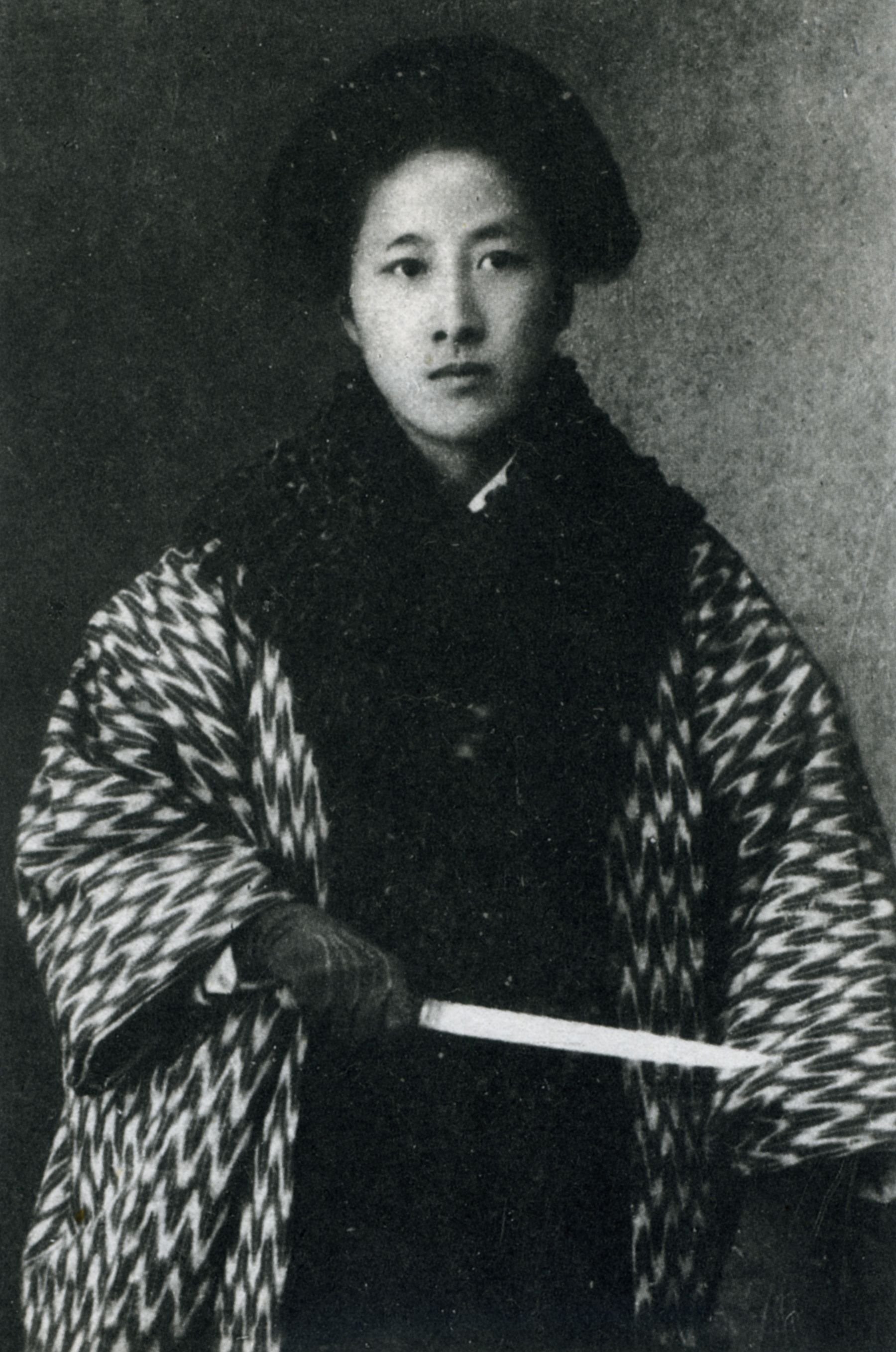
Qiu Jin
Two Poems by Qiu Jin, poet
Photo Credit, public domain
Qiu Jin was a Chinese revolutionary and feminist who fought with sword and pen for the establishment of a republic as well as equality, education, and governmental representation of women. She founded the magazine Chinese Women’s Journal in which she protested foot binding and arranged marriages and encouraged women to see themselves as the driving force for progress and change. Qiu Jin saw the comforts and protection afforded to her sex as being dangerous boundaries to independence. In 1904, she sold all of her jewelry and left behind her husband and two children moving to Japan where she would study martial arts and community organizing. Her writings and lectures were delivered in formal settings as well as vernacular publications to optimize inclusion and she encouraged her fellow teachers to inspire students to get involved with nationalism and gender equality.
Upon returning home to China, she recruited soldiers and students to the movement and established the Restoration Army with the plan of leading a major uprising. After it became clear that the resistance efforts would fail, Qiu Jin encouraged her followers to disengage in an attempt to avoid capture, but she refused herself this protection resulting in her capture, interrogation, torture, and execution. Her final poem states, “I weep for loss of country…I live on in sacrifice, I have fulfilled my duty.”

Anthony R. Green
Zachte Krachten, composer
Photo Credit, Colin Conces
Anthony R. Green (he/him/his), composer/performer/social justice artist, was raised on Narragansett and Pauquunaukit (Wampanoag) land in Providence, RI. His various creative projects include musical and visual creations, interpretations of original, contemporary, and repertoire works, collaborations, educational outreach, and more. Behind all his artistic endeavors are the ideals of equality and freedom. His compositions and projects have been presented in 25+ countries by various internationally acclaimed soloists and ensembles including but not limited to: Julian Otis (voice), Fred C. VanNess Jr. (voice), Veronica Williams (voice), Christian Dillingham (contrabass), Joy Cline Phinney (piano), Elizabeth G. Hill (piano), Ashleigh Gordon (viola), the Chicago Modern Orchestra Project (conducted by Renée C. Baker), and Castle of our Skins. Venues which have hosted his projects include Jordan Hall (Boston), Tivoli Vredenburg (Utrecht, the Netherlands), Spike Gallery (Berlin), the Israel Conservatory of Music (Tel Aviv), the Shoe Factory (Nicosia, Cyprus), and Symphony Space, Spectrum, and the Marian Anderson Theater (New York), among others. As a performer, he specializes in piano performance, experimental vocalizations, improvisation, movement, and performance art. He has performed projects ranging from traditional recitals to interdisciplinary performances in the US, the UK, the Netherlands, Germany, Turkey, South Korea, and Switzerland. A former McKnight Visiting Composer, Green has been invited to numerous residencies in the US and Europe, including Space/Time (Scotland), the Visby International Centre for Composers (Sweden), and the Bemis Center for Contemporary Arts (Omaha, Nebraska), and has recently received an invitation to the "perfocraZe International Artist Residency" (pIAR) in Kumasi, Ghana. He is the co-founder and associate director of Boston-based Castle of our Skins, dedicated to celebrating Black artistry through music. When not traveling, Green enjoys a variety of activities, many centered around Black and queer identities. He currently resides in Leiden, the Netherlands, with his MRI physicist/pianist partner, Dr. Itamar Ronen.

Henriëtte Roland Holst
Zachte Krachten, poet
Photo Credit, Elsbeth Etty
Henriëtte Roland Holst, nicknamed “Aunt Jet” was a poet and socialist leader deeply involved in resistance publications and efforts helping Indonesian immigrants in the Netherlands, as well as Marxist parties. Much of her life was afflicted with depression, eating disorders, and other ailments but she was steadfast in her commitment to creating a better society, especially fighting for youth, women, immigrants, and the labor workforce. She was a firm believer in Marxism and socialist methodologies but was mortified by the governmental oppression created with the communist movement. After speaking at a large Soviet gathering, she published a book challenging the militant direction she witnessed within the communist movement and containing the poem “De Zachte Krachten zullen zeker winnen” (The Soft Powers will win in the end). In addition to her poetry, she wrote biographies Rousseau, Gandhi, and Tolstoy as well as copious contributions to a variety of journals and even radio plays.

Michael Wiener
Maagal, composer
Photo Credit, Hardy Wiener
Michael Wiener, born in 1975 in Germany, combines his interest in contemporary music, especially composition, with his academic background in international law. From 2002 until 2006, he was a member of the composition class of Alexander Müllenbach at the Conservatory of Luxembourg, where he received a composition certificate ‘supérieur avec la qualification très bien’. He was also awarded prizes at the composition competitions Carl von Ossietzky, Engelbert Humperdinck and Artistes en herbe. His choir piece ‘Major autem ex his est caritas’ has been chosen as a winner in the composition contest of Universal Sacred Music in New York City and was recorded by Harold Rosenbaum with the New York Virtuoso Singers (published on CD by Soundbrush Records). In addition, his piece ‘Camino de Santiago’ was recorded on CD by the female ensemble Otto Voci.
His compositions were selected in calls for scores by Vox Novus, Via Nova Choir, Fidelio Trio, the Choral Composer/Conductor Collective and Voice for the Voiceless. His choir works featured in international festivals, including the Festival of Universal Sacred Music in New York, Rhythms of One World in Geneva, Schubertiade in Bienne, Biennale d’art sacré contemporain in Paris, and the London Festival of Contemporary Church Music.
In addition, he completed his doctoral thesis at the law faculty of the University of Trier and also holds a Master of Laws degree from the University of London. In his LL.M. thesis, he analyzed legal notions and copyright issues in the last piano sonata of Viktor Ullmann (1898-1944), thus exploring further the links between music and law. Since 2011, he has also been a visiting fellow of Kellogg College at the University of Oxford.

The Girls of Room 28
Maagal, text authors
Photo Credit, still photo from Nazi Propaganda film
Room 28 was a small refuge within the Theresienstadt internment camp. Elders including artists and educators prioritized these children with the utmost hope and resilience, often sharing their rations, playing games with them, teaching them, and entertaining them with performances of operas, concerts, and theater. Fredy Hirsch, a Zionist youth leader, said "We had to try to save the children from the debasement of all that is good." With Jewish education forbidden throughout the German Reich, these elders worked in secret to teach history, music, language, art, morality, and philosophy. Composer Victor Ulman was one such elder and at one point the inmates composed and performed an opera together.
Maagal, which translates to perfection and circle, became the name of a child-led club of girls 12-13 years old. Here the children organized themselves into a democratic organization with uniforms, a flag, anthem, and motto, which was used as an incantation or secret password, “You believe me – I believe you. You know what I know, whatever may happen, you won’t betray me – I won’t betray you.” Their anthem, set to the Czech folk song ‘Ach padá, padá rosička’ (‘The Dew Is Falling’) states: “We want to be united…we have come here, but our hope…is to return home again…We shall drive every evil away and won’t go home until we have…We clasp each other’s hands and sing this anthem of our home.” Helga Polak remembers in her diary, “Girls who are attentive, diligent, amicable and who set a good example are represented in Ma'agal.”
When German journalist, Hannelore Brenner, came across the story of these girls, she reached out to two survivors, Anna Hanusová and Helga Kinsky. Together they organized reunions, interviews, and eventually founded Room 28 Projects, an organization that has curated museum exhibits and published their story in books, diaries, and a play in a number of translations.

Molly Joyce
The Beauty of Disability,
composer & text contributor
Photo Credit, Shervin Lainez
Composer and performer Molly Joyce has been deemed one of the “most versatile, prolific and intriguing composers working under the vast new-music dome” by The Washington Post. Her music has additionally been described as “serene power” (New York Times), and “unwavering…enveloping” (Vulture). Her work is concerned with disability as a creative source. She has an impaired left hand from a previous car accident, and seeks to explore disability through composition, performance, collaboration, community engagement, and further mediums. Her most recent album, Perspective, featuring forty-seven disabled interviewees responding to what access, care, interdependence, and more mean to them, was released on October 2022 on New Amsterdam Records. The record has been praised by Pitchfork as “a powerful work of love and empathy that underscores the poison of ableism in American culture” and The Wire as a “powerful ongoing project…charged by an intense composer/performer relationship.”
The primary vehicle in her pursuit is her electric vintage toy organ, an instrument she bought on eBay that suits her body and engages her disability on a compositional and performative level. Her debut full-length album, Breaking and Entering, featuring toy organ, voice, and electronic sampling of both sources was released in June 2020 on New Amsterdam Records, and has been praised by New Sounds as “a powerful response to something (namely, physical disability of any kind) that is still too often stigmatized, but that Joyce has used as a creative prompt.”
Molly’s creative projects have been presented and commissioned by Carnegie Hall, TEDxMidAtlantic, National Sawdust, Music Academy of the West, Gaudeamus Muziekweek, National Gallery of Art, and featured in outlets such as Pitchfork, eBay, Red Bull Radio, WNYC’s New Sounds, and I Care If You Listen. Her compositional works have been commissioned and performed by ensembles including the Vermont, New World, and Milwaukee Symphony Orchestras, as well as the New Juilliard, Decoda, Contemporaneous ensembles, and Harvard Glee Club. She has also written for publications 21CM, Disability Arts Online, Women in Foreign Policy, and is a member of the Americans for the Arts’ Artists Committee.
Her debut EP, Lean Back and Release, was released in January 2017 on New Amsterdam Records was praised as “energetic, heady and blisteringly emotive” by Paste Magazine and “arresting” by Textura. Molly is a graduate of The Juilliard School, Royal Conservatory in The Hague, and Yale School of Music. She holds an Advanced Certificate and Master of Arts in Disability Studies from CUNY School of Professional Studies. She is currently a Dean’s Doctoral Fellow at the University of Virginia, focusing on Composition and Computer Technologies.

Judith Heumann
The Beauty of Disability,
text contributor
Photo Credit, Neha Balachandran
Judy Heumann was a lifelong advocate for the rights of disabled people. She contracted polio in 1949 in Brooklyn, New York and began to use a wheelchair for her mobility. She was denied the right to attend school because she was considered a "fire hazard" at the age of five. Later in life, Judy was denied her teaching license after passing her oral and written exams, but being failed on her medical exam. Judy sued the Board of Education and went on to become the first wheelchair user to become a teacher in the state of New York. Judy became an internationally recognized leader in the disability rights community. She was instrumental in the development and implementation of legislation, such as Section 504, the Individuals with Disabilities Education Act, the Americans with Disabilities Act, the Rehabilitation Act, and the UN Convention on the Rights of Persons with Disabilities which have been advancing the inclusion of disabled people in the US and around the world and fighting to end discrimination against all those with disabilities.
Judy was a founding member of the Berkeley Center for Independent Living which was the first grassroots center in the United States and helped to launch the Independent Living Movement both nationally and globally. In 1983, Judy co-founded the World Institute on Disability (WID) with Ed Roberts and Joan Leon, as one of the first global disability rights organizations founded and continually led by people with disabilities that works to fully integrate people with disabilities into the communities around them via research, policy, and consulting efforts. Up to her recent death, she served on a number of non-profit boards, including the American Association of People with Disabilities, the Disability Rights Education and Defense Fund, Humanity and Inclusion, Human Rights Watch, United States International Council on Disability, and Save the Children.
From 1993 to 2001, Judy served in the Clinton Administration as the Assistant Secretary for the Office of Special Education and Rehabilitative Services in the Department of Education. Judy then served as the World Bank's first Adviser on Disability and Development from 2002 to 2006. In this position, she led the World Bank's disability work to expand its knowledge and capability to work with governments and civil society on including disability in the global conversation. During his presidency, President Obama appointed Judy as the first Special Advisor for International Disability Rights at the U.S. Department of State, where she served from 2010-2017. Mayor Fenty of D.C. appointed her as the first Director for the Department on Disability Services, where she was responsible for the Developmental Disability Administration and the Rehabilitation Services Administration.

Marco Grosse
The Beauty of Disability,
text contributor
photo credit, Galya Popova
Marco Grosse was born 1974 in Buenos Aires, in a German-Italian family. He is a poet, writer and translator who has lived in Argentina, Canada, Egypt, Italy and Germany. Grosse has published several collections of short stories and poetry in German and Italian. His texts are published in anthologies and different literary journals. He translated important Italian poets into German, such as Alda Merini. In English he regularly writes poems for magazines and song texts. He has been described as “a poet who found his place on the road between languages” (Michael Braun). Marco Grosse collaborates with international artists of different disciplines.
Learn more about Marco Grosse.

Lauren McCall
Living Water,
composer and lyricist
Photo credit, Alexandria McCall
Lauren is a composer and educator from Atlanta, Georgia. She studies music technology at the Georgia Institute and is an alumni of the Vermont College of Fine Arts where she studied music composition. Lauren is an active music educator developing curriculum for the websites EarSketch and TunePad through her graduate research assistantship at Georgia Tech.
Lauren has had compositions performed around North America and in Europe. This includes her piece for piano, Shake the Earth, which was performed in Morehead, Kentucky at Morehead State University’s Contemporary Piano Festival, along with being performed in Eugene, Oregon at the Oregon Bach Festival Composers’ Symposium. Her arrangement of the spiritual I’m Troubled was performed in Lakeland, Florida at Florida Southern College for the Grady Rayam Prize in Sacred Music, and her graphic score composition The Fish Wife was performed in Montreal, Canada by the ensemble Amis Orgue Montreal. Along with composing Lauren also enjoys playing classical music and jazz on the clarinet and piano, spending time with family and friends, and traveling.

Jason Cady
AOC Takes the Floor, composer
Photo credit, Nina Roberts
Jason Cady is a composer and librettist. He performs on pedal steel guitar and modular synthesizer. Pitchfork called him a “mod-synth mastermind…funny and engaging.” Anthony Tommasini, in the New York Times, described his video opera, I Screwed Up the Future, as “charming fantasy...drably comic and spacey.” Opera News described his opera I Need Space as “delightfully weird...hilarious, dry and detached performances made this futuristic, retro story of love and rejection endearingly poignant.” His recent opera, Candy Corn, was called “hilarious” by The Wire Magazine, and “radically enjoyable” by I Care If You Listen.
Cady’s CDs have been released on Lockstep Records and Peacock Recordings, and his podcast opera, Buick City, 1:00 AM is available on Apple Podcasts. The Brooklyn Arts Council, New Music USA, free103point9, The Casement Fund, Lighton International Artists Exchange, and the American Music Center have funded his projects. His music has been performed at Roulette, Issue Project Room, The Stone, (le) Poisson Rouge, Symphony Space, Merkin Hall, Abrons Art Center, Anthology Film Archives, CBGB’s, Tonic and many other venues in New York City and throughout the US. He has lectured on his music at New York University, New School University, Wesleyan University and Arizona State University. He has been interviewed on WBEZ, WNYC, WKCR, WPIR, KMFA and East Village Radio. NPR featured him in “The Mix: 100 Composers Under 40.” The University of Michigan Press published his essay on Earle Brown in “Beyond Notation: the Music of Earle Brown.”
Cady has an M.A. in composition from Wesleyan University, where he studied with Alvin Lucier and Anthony Braxton. He graduated magna cum laude with a B.A. in Interdisciplinary Arts and Performance from Arizona State University, where he studied composition with Richard Lerman, Harold Budd, and Daniel Lentz. He was born in Flint, Michigan and now lives in New York City. He is an enrolled member of the Sault Ste Marie Tribe of Chippewa Indians.

Alexandria Ocasio-Cortez
AOC Takes the Floor, text author
Photo credit, Franmarie Metzler
Alexandria was born in The Bronx to working class parents: her father was a small business owner and architect from the South Bronx, and her mother cleaned homes after moving to New York from Arecibo, Puerto Rico. As school violence and dropout rates in The Bronx rose in the early 90’s, her parents put their savings together and purchased a modest home 30 miles north of the city in search of better schools for the family. As a result, much of Alexandria’s adolescence was spent in transit between her tight-knit extended family in The Bronx and school in Yorktown Heights. It struck Alexandria as unfair, even then, how the opportunities available to children and their families were often based on their ZIP code.
Alexandria went on to study Economics and International Relations at Boston University. At the start of her sophomore year, Alexandria's father passed away suddenly from cancer at just 48 years old. Facing huge medical bills, the family risked foreclosure and her mother took another job driving a school bus. The unjust medical debt left a lasting impression on Alexandria, and she sought out an internship in the late Sen. Ted Kennedy’s office. Upon graduating college, Alexandria came back to The Bronx and pursued work in education and community organizing: as an Educational Director for the National Hispanic Institute, she worked with promising high school youth to expand their skill-sets in community leadership and social enterprise; she also piloted projects to help improve literacy skills in young children and middle-schoolers. But as the economy floundered, Alexandria found herself working two jobs and 18-hour shifts in restaurants to help keep her family afloat, while balancing student loan and insurance payments.
After Donald Trump won the presidency in 2016, Alexandria joined many Americans who felt a strong calling to do more in civic life. That December, she traveled to the Standing Rock Reservation in North Dakota where indigenous people were demonstrating against a dangerous gas pipeline. Alexandria was inspired by the experience and, shortly thereafter, decided to run for Congress. Despite being a political longshot – she received no major endorsements and was outspent nearly 10 to 1 by her opponent – Alexandria won her primary challenge on June 26, 2018, and went on to win the election, becoming the first woman of color to represent NY-14, and the youngest woman in history to serve in Congress.

Özden Gülsün
Al Kan Kuşak, composer
Photo credit, Roza Keskin
Born in 1983 in Izmir, Özden Gülsün started her music education in Mimar Sinan Fine Arts University State Conservatory as a violin student under Prof. Gönül Gökdoğan. She continued her violin education in Dokuz Eylül University State Conservatory under Prof. Attila Işıksun and Teaching Assistant Şebnem Edgü. In 2004, she was admitted to the Composition and Conductor Department of DEÜ State Conservatory and started studying under Prof. İstemihan Tavioğlu. In 2009, she was admitted to the post-graduate program of the same department and started teaching solfege and music theory the same year. She studied under Prof. Jean Baily, Ass. Prof. Ebru Güner Canbey, Ass. Prof. Onur Nurcan, and Teaching Assistant Mehmet Aktuğ throughout her education. In 2013, she started working as a research assistant in the Music Department of Trakya University State Conservatory. She completed her post-graduate studies with her thesis titled Examination of Atonal, Serial, and Minimal Styles and their Explanation through Select Examples at TÜ Institute of Social Sciences with Prof. Ahmet Hamdi Zafer ve Ass. Prof. Ebru Güner Canbey as her thesis advisors and she continues her doctorate education at the same institution.
She attended to masterclasses of Mark Mellits, Michael Ellison, Kamran İnce, Dimitris Andrikopoulos, Jan Feddersen Stathis Gyftathis, and Richardo Valligni during her composition studies. Her works have been played in various chamber concerts. Her orchestral work titles Ütopya (2009) was played by DEÜ State Conservatory Student Orchestra at Izmir Sabancı Art Center. In 2010, she participated in the “Mehmet Aktuğ Commemoration Concert” hosted by Ahmed Adnan Saygun Art Center with her work titled Yalnızlık (2010). In 2011, she attended to the “Klasik Keyifler Chamber Music Festival” masterclass and her work Kırık Ayna (2010) was played during the “Composers’ Cauldron” concert at KMYO Ottoman Madrasah, Cappadocia. In 2012, her work titles Kaleidoscope (2012) was played by Prof. Şeniz Duru Koevoets, Prof. Ümit İşgörür, and Yonca Alpay as part of the fifth “Journey of the Sound, Young Composers Festival” at İTÜ MİAM – Maçka Campus, Mustafa Kemal Amphiteater. In 2016, she attended to the concert performed as part of the “6th Synthermia International Music Festival” hosted in Thermi Municipality Conservatory Concert Hall in Thessaloniki, Greece with her work titled Hystheria (2016).
In November 2020, she was selected as one of the composers to attend to “Deterritorializing the Realm of New Music” Call for West Asian Composers Commissions” hosted by Canadian Music Center. The work she has composed for the “Deterritorializing the Realm of New Music” Call for West Asian Composers” Project will be played by Anoush Moazzeni (pianist) in Canada in 2021.

Didem Gülçin Erdem
Al Kan Kuşak, librettist
Photo credit, Didem Gülçin Erdem
Didem Gülçin Erdem was born in Malatya-Turkey in 1989 and studied Turkish Language and Literature at Beykent University in Istanbul-Turkey. Erdem received her Master’s degree from Pamukkale University, Department of Turkish Language and Literature. With a focus on Folklore, her thesis is titled “Madmen and Madness in Denizli Folk Culture.” Didem completed her doctorate in Turkish Language and Literature with her thesis titled “Alevi-Bektashi Gulbanks – A Context- Centered Approach.” Her poetry and articles have been published in various magazines since 2004. She works at Pamukkale University, Department of Turkish Language and Literature. Published works include Perdesiz, Yasakmeyve, 2010; Olmayanım İçinizde, Everest, 2012; Boşluklara Doğru İlerleyelim, Edebi Şeyler, 2019.

Myron Silberstein
Prayers for Peace, composer
Photo credit, Daniel Johanson
Myron Silberstein is a Chicago-based composer and pianist whose writing falls within the tradition of the overlooked composers whose works he has premiered and recorded. Vittorio Giannini, Ernest Bloch, Nicolas Flagello, and Thomas Pasatieri are among Myron’s greatest influences, and he embraces the unabashed emotionalism, melodic and harmonic warmth, and structural rigor of these composers. Myron’s output includes a large number of songs, works for solo piano, and duo-sonatas. He particularly enjoys collaborating with living poets. His recordings can be found on Naxos, Centaur, and Connoisseur Society. Mark Lehman of the American Record Guide lauded Myron’s recording of sonatas by Peter Mennin and Norman Lloyd as “An indispensable addition to the discography of American music.” A recording of Myron’s first two piano sonatas and unpublished piano pieces and songs by Vittorio Giannini is currently in postproduction.